
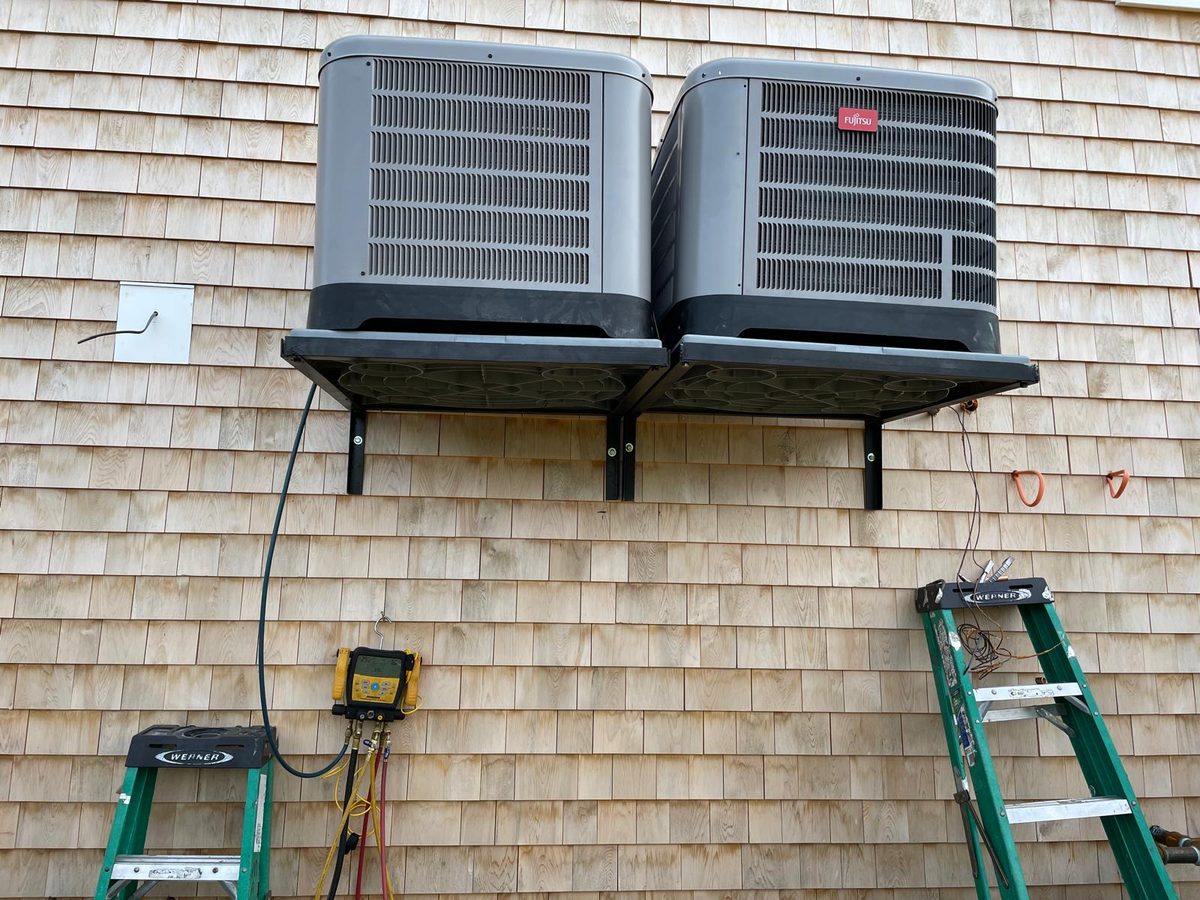
HVAC Services in Norfolk, MA
Quick Answer
In Norfolk, 95.4% of households own their home, 91.1% of housing units are single-family detached, and 62.8% of homes burn oil (ACS 2022). With so few rentals and so little gas, a replacement usually means oil versus a heat pump. Free written estimates: call (508) 786-8755.
Free HVAC Quote in Norfolk
Our Services in Norfolk, MA
Click any service for details specific to Norfolk.
A town where almost everyone owns the house
In the Census Bureau's 2022 American Community Survey (ACS), Norfolk has 3,291 occupied homes, and 3,138 of them (95.4%) are owner-occupied. Only 153 households rent (4.6%), the lowest share of all 50 towns we serve, against 16.4% for the middle town. Single-family detached houses make up 3,107 of the 3,412 housing units (91.1%), 5th-highest of the 50, and no unit is a mobile home.
The rental heat rules in the State Sanitary Code touch a much smaller share of households here than in most of our towns. In an owner-occupied house, the owner generally makes the decisions about oil tanks, ducts and attic insulation. Multi-unit buildings are only 135 of the housing units (4.0%).
Oil tanks and LP cylinders instead of gas lines
Fuel oil or kerosene heats 2,067 Norfolk homes, 62.8% of occupied homes and 7th-highest of the 50 towns, well above the 36.5% of the middle town. Bottled or tank (LP) gas heats 363 more (11.0%), 4th-highest. Utility gas serves 566 homes (17.2%), 44th of 50, and electricity heats 159 (4.8%), 49th of 50. Wood is the fuel for 52 homes.
A replacement here often begins with an existing oil boiler or furnace. The decision is often one of three: a new oil unit, a cold-climate heat pump with the old system as backup, or a full move to heat pumps. Gas conversion is possible only where a main reaches the street, and the gas company can confirm that. We assess the home's heating load before quoting, because oversized equipment can waste fuel and wear out sooner.
Mostly built from 1960 on, with the biggest wave from 1980 to 1999
The median Norfolk home was built in 1982, seven years newer than the 1975 of the middle town. The largest group, 1,212 units (35.5%), went up between 1980 and 1999. Another 925 (27.1%) date from 1960 to 1979, and 426 (12.5%) from 1940 to 1959. Only 179 (5.2%) are from 1939 or earlier, 49th of 50, and 44.8% were built before 1980. At the newer end, 450 homes (13.2%) are from 2010 or later, 5th-highest.
A house from that wave may not have the problems of a pre-war one, but an original furnace or boiler of that age can be near the end of a normal service life. Newer houses are also generally tighter, which can make ventilation and correct sizing more important. The median home value is $649,800, against $579,150 for the middle town.
Mills, a rail line and a prison: what Norfolk's record says about its growth
Norfolk sits on an upper valley of the Charles River and was part of Dedham, then of Wrentham, where it was known as North Wrentham. It separated and was incorporated as Norfolk in 1870. Villages formed around sawmills and gristmills in the 17th and 18th centuries, and three cotton manufacturing companies were established at Stony Brook after 1812. The Norfolk County Railroad opened in 1849.
Population rose rapidly after 1925, when a hospital and a state prison were built on the Walpole line. Major residential development took place before 1940 in the Pondville and Clark Streets section, with scattered new housing along Seekonk and Main Streets, and suburban building has continued since. Norfolk covers 15.2 square miles, of which 14.8 are land.
Rebates and the electric utility
We cannot confirm Norfolk's electric utility from the data we hold. Mass Save heat pump rebates run through the utility that serves the address, so find out which one that is before you order equipment. The heat pump page has the 2026 terms.
| Norfolk, MA at a glance (ACS 2022) | Figure |
|---|---|
| Population | 11,527 |
| Housing units | 3,412 |
| Median year homes were built | 1982 |
| Owner-occupied households | 95.4% |
| Homes heated with fuel oil | 62.8% |
| Homes heated with LP gas | 11.0% |
| Median home value | $649,800 |
Mass HVAC near Norfolk
How It Works
Call or send the form
Get a written estimate
Pick a time
Job done right
No Heat? No AC? We're On It.
Rated 5 out of 5
“Excellent customer service ❄️🔥”
Robert Rangel SilvaGoogle · Translated from Portuguese
Service Areas Near Norfolk
We also serve these nearby MetroWest towns.
Frequently Asked Questions About HVAC in Norfolk
Common questions about our HVAC services in Norfolk, Massachusetts.
It depends on the house. With 62.8% of Norfolk homes on oil, this is a common choice. A heat pump can carry most of the load in a well-sealed house, and some owners keep the boiler for the coldest days. The heating load is assessed before a system is quoted.
Only 17.2% of Norfolk homes use utility gas, so a main may not reach every street. The gas company can tell you whether one reaches your address, and the answer decides whether conversion is even an option. If not, oil, LP or a heat pump are the paths.
If it has never been replaced, it is more than three decades old, which is past the usual life of many boilers and furnaces. Age alone does not mean failure, but an annual tune-up can show how much life is left, and we can price a replacement ahead of a breakdown.
Unless the lease says otherwise, the landlord pays under the State Sanitary Code, which requires at least 68 F from 7 a.m. to 11 p.m. and at least 64 F overnight during the heating season. This is general information, not legal advice. Rentals are only 4.6% of Norfolk households.